Earlier this year our lab ran the first UPEI Transportation Survey. This is part of a series of projects that aim to make it easier to get to and from the UPEI Charlottetown campus using active and sustainable means, which include walking/wheeling, biking, taking transit, or carpooling. In other words, anything that doesn’t involve driving alone in a car, which has far higher financial, health and environmental costs than pretty much any other option for getting to and from campus.
We are still analyzing the results, but a basic summary of the findings are below.
Table 1. Participant Characteristics.
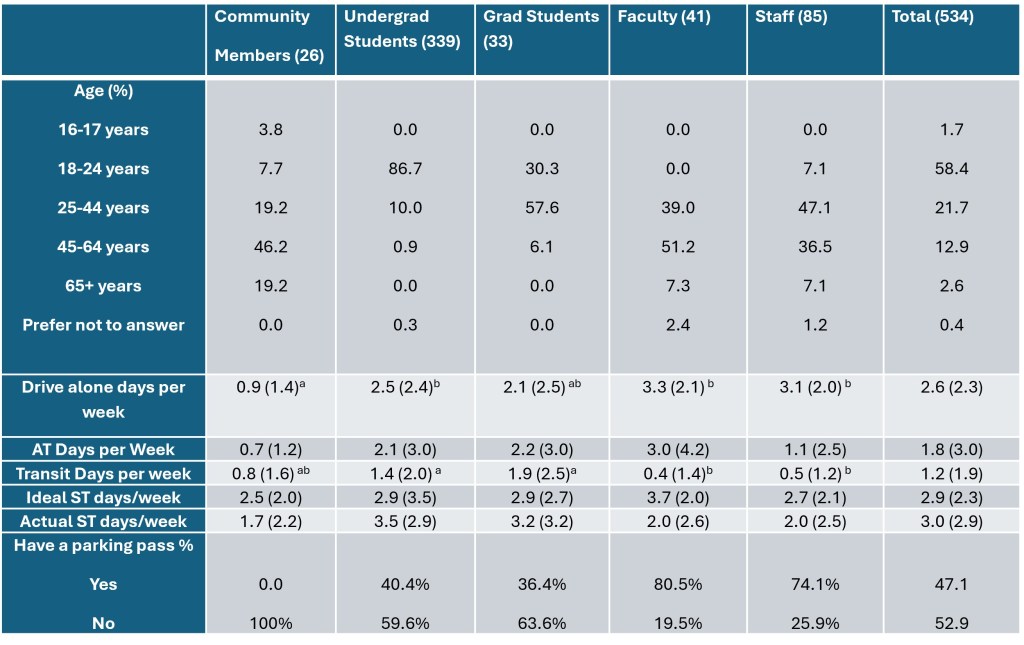
As shown in Table 1, the majority of respondents were students, but we did get a good number of responses from faculty and staff, and a handful of community members.
On average, people said they drove alone 2.6 days/week, although this varied by groups – students, faculty and staff were all more likely to drive than community members (although this may be influenced by which community members were motivated to answer the survey). Students took the bus 1.4-1.9 times/week on average, compared to just 0.4-0.5 times/week for faculty and staff. More than half of participants did NOT have a parking pass – 40% or less of students reported having a pass, compared to 81% for faculty and 74% for staff.
Table 2. Commuting preferences
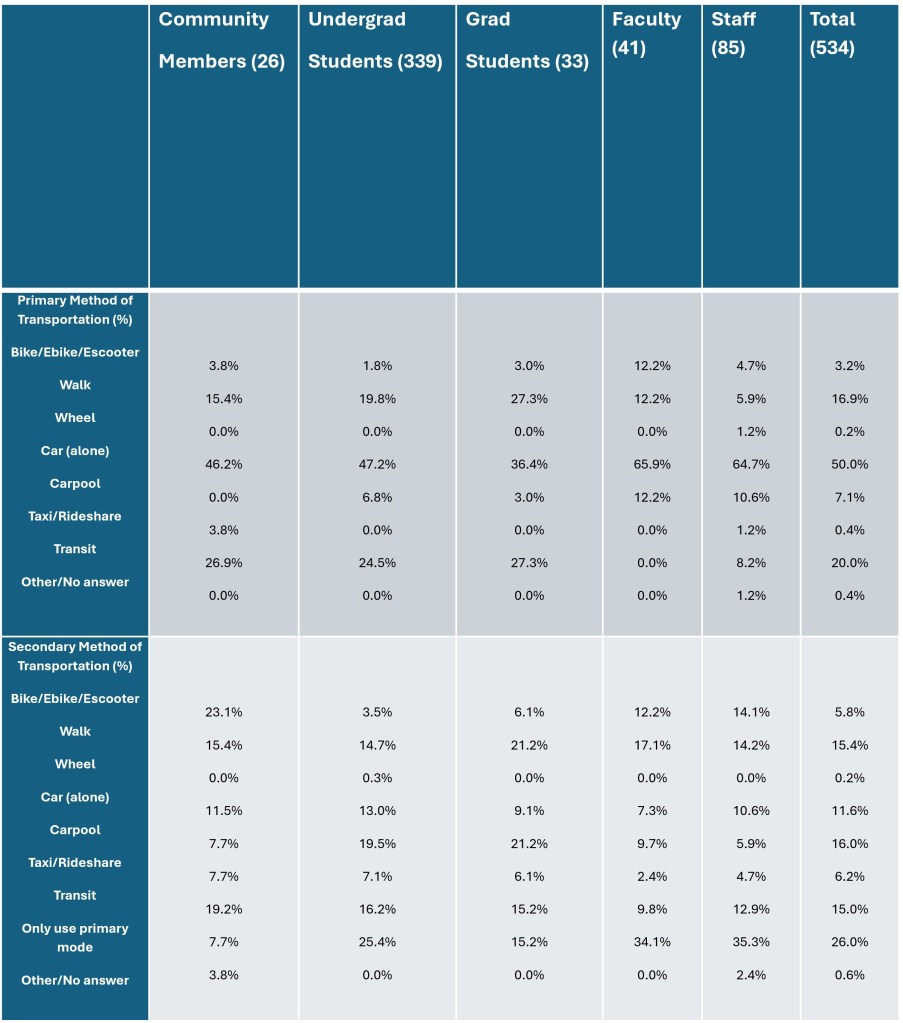
As shown in Table 2, the primary method of getting to campus was driving alone for exactly 50% of participants. However, this was more common for faculty and staff (~65%) than students (36-47%). Students were also more likely to have a backup method of getting to campus, whereas roughly 35% of faculty and staff only had a single way to get to campus.
Across all groups, the top barriers for walking were distance, weather, and time, while the top barriers for cycling were distance, weather, lack of equipment and safety. The primary barriers to transit use were lack of routes, frequency of routes, and routes not operating when needed. In other words, having a bus that will take you were you want to go around the time you want to get there. The primary barriers to carpooling were not having anyone to carpool with, time and convenience.
We are in the process of completing a thematic analysis of the long-form comments, but broadly speaking they align with the above rankings. There were also a number of concerns brought up regarding the amount and quality of parking on campus, and many comments focused on the benefits of improving infrastructure for all forms of transportation both on and off campus (roads/parking lots, sidewalks, bike lanes, bus shelters, lighting, bike racks, etc). Not surprisingly, many of the comments also focused on particular challenges for individuals living outside of Charlottetown itself, where distance, time, and access to transit have the biggest impact.
What does this all mean?
One important take-home message from this is that not everyone drives to campus. Although this sample only represents about 10% of the campus community, we still found that more than 40% or respondents do not drive as their primary way of getting to campus, and less than half of respondents have a parking pass. This means that sustainable transportation is already really common on campus, and probably more common than most realize. In fact, one common theme from the written comments was that some people who drive assume that everyone drives – for example, by commenting that more or cheaper parking spots will benefit everyone. Many people do drive, but comments like this highlight the fact that driving and parking on campus are not as universal as it may seem to those who are driving.
It’s clear that there are some structural barriers to walking or biking to campus, especially in winter. There are examples of other places, like the Finnish town of Oulu, where walking and cycling in winter are totally normalized, but changing social norms can take a lot of time. However, many other barriers are things that can be addressed – adding sidewalks, separated bike lanes, lighting, bus shelters, etc, can make active transportation safer and more convenient (and places like Oulu tend to have really great infrastructure that allow people to safely and conveniently walk and bike year round). Ensuring that bus service is fast and frequent to and from campus (and that it includes an option for students traveling in the evening or on weekends) could address the vast majority of barriers regarding transit use. That’s not to say that these solutions are simple or easy to implement, but they are still things that can be addressed over time.
What is next?
Once our thematic analysis is complete, we will be creating a list of specific recommendations for different stakeholders on and off campus to address the challenges that people experience coming to and from campus. The hope is that this will make it easier for everyone to get to and from campus, while making sustainable options more convenient and appealing.
Travis


Leave a Reply