
I have a question for you: Is it safe to use a rope swing?
That might seem like a strange question. But if you asked my father in law, he’d have a clear and immediate answer: absolutely not.
My father in law spent 30+ years as an emergency room doctor, and he saw a few kids get really seriously injured on rope swings. Kids can fall off a rope swing in several ways – the rope can snap, the tree branch holding the rope can snap, or the kid can simply fall off the swing. So it’s not surprising that some kids would get hurt, and that some of those injuries might lead to spinal cord or other serious injuries. And over a career of 30+ years in the ER, you might see enough of those injuries to decide that you would absolutely never allow your own kids or grandkids use one.
There are papers to back him up by the way. Here is a study from Pediatrics, one of the most prestigious journals related to child health:
Objective. To examine the scope and severity of injuries sustained from falls from single rope tree swings among children.
Methods. Twenty-six children formed the basis of this retrospective study. Patients were divided into three groups based on the estimated distance of their fall (one, two, or three stories). Data were analyzed with respect to mechanism of injury, age, gender, length of hospital stay, injury severity score, number and type of injuries, and mortality.
Results. Eighteen patients fell from ropes, and 8 from vines (all onto packed dirt). Fourteen falls occurred from one story or less, 8 from two stories, and 4 from three stories. One death occurred from intracranial injury following a two-story fall. No difference in age, gender, injury severity score, or length of hospital stay with respect to the height of the fall was observed. Falls from lower heights resulted in equally severe injuries as falls from higher heights. Overall, head trauma was the most common injury (58%) followed by long bone fractures (42%), axial skeletal fractures (23%), and intra-abdominal visceral injuries (8%).
Conclusions. The present study demonstrated that recreational single rope tree swing injuries among children resulted in significant morbidity regardless of the height of the fall. This activity carries a substantial risk for serious injury. The mechanism of injury, clinical data, and the importance of medical awareness and patient education are emphasized.
The above paper even has a great figure demonstrating why these swings are dangerous, and the forces at different points in time:
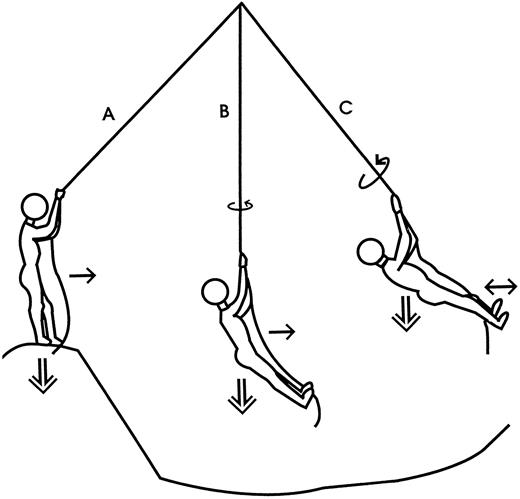
Source: Albanese et al., Pediatrics.
Another study looked specifically at river rope swings, and it may not surprise you to know they concluded that “The most hazardous risk factors…are use by a non-swimmer, shallow water, extreme fall distance, and presence of a small diameter retrieval line” (Emphasis mine).
So it’s probably safe to say that when a rope swing injury requires medical attention, those injuries are often pretty bad. But does that really tell us how risky rope swings are? Public health guidelines usually focus on a large population. And to understand risk, we need to also understand how many people are engaging in that behaviour. This allows us to convert it into a rate, which makes it much easier to understand and compare.
For example, we might want to divide the number of rope swing injuries in a province by the total number of rope swingers. Let’s say there are 5 serious rope swing injuries in Ontario each year, and 1000 kids using rope swings over this time period (these numbers are completely fictional). This would mean that 0.5% (e.g. 5/1000) of rope swingers get seriously injured each year.
In the above example, the numerator is the number of kids getting injured each year (5). The denominator is the total number of kids using rope swings (1000). Clinicians only get to see the numerator. They don’t know the number of people engaging in the behaviour, which means they never know the denominator. This is the denominator problem.
By the way – this is not a dig at clinicians. But it is a limitation we need to remember anytime we are trying to figure out the risk of an activity when you don’t know the size of the population you are dealing with. Here is a good older article from the journal Canadian Family Physician diving into the denominator problem in more detail with respect to primary care.
Why does all of this matter? Without a denominator, we can’t compare the risk of different activities, or across groups of people. Let’s take another rope swing example. Let’s say that of the 1000 kids who use rope swings in Ontario every year, 800 are boys. Let’s also say that of those 5 serious injuries, 4 are girls. This would mean that the rate of injuries among boys is 1/800 (0.125%) but among girls is 4/200 (2%). That’s really important to know, because for some reason girls in this fictional example are less likely to use rope swings, but more likely to be injured.
To take a real-world example, a recent study looked at sudden cardiac arrest (SCA) among young athletes. They found 27 deaths due to SCA among White athletes, and 23 among Black athletes, which looks roughly similar. But there were 67 cases of SCA among White athletes, and just 39 cases among Black athletes, meaning that 60% of White athletes survived their SCA, while just 33% of Black athletes survived theirs. That is a very large difference, which makes a huge impact on how we go about reducing deaths from SCAs.
If we don’t know the denominator, we can’t make evidence-informed health policy. Based on the number of deaths alone, you might assume that impact of SCAs are similar for White and Black athletes. But once you know the denominator, it becomes clear that Black athletes are far more likely to die from an SCA, which means we need policies that take that into account (in this case, we probably need to ensure that all gyms have AEDs, as a starting point to reduce this gap).
The denominator problem is more obvious for clinicians, but it impacts all of us. We all avoid certain behaviours (cycling on roads, playing on monkey bars, letting our kids walk to school on their own) because we perceive it to be dangerous. We may have known someone who got hurt doing it, or read about something in the news. The numerator really stands out to us. But many of these things are objectively very safe when you look at the actual statistics, which take into account the denominator.
All of which finally brings me to the reason why I am thinking about the denominator problem.
My son is really keen to buy an escooter. There have been a lot of headlines recently about escooters, so as both a parent and an active transportation advocate, it seemed like a good time to start diving into that research to understand just how risky they are. The denominator is going to be really important in understanding those risks, how they compare to other activities, and ultimately deciding what sorts of rules we should have in our house (and our bylaws) around escooters. I’ll be back with a post diving into all of these topics soon.


Leave a Reply