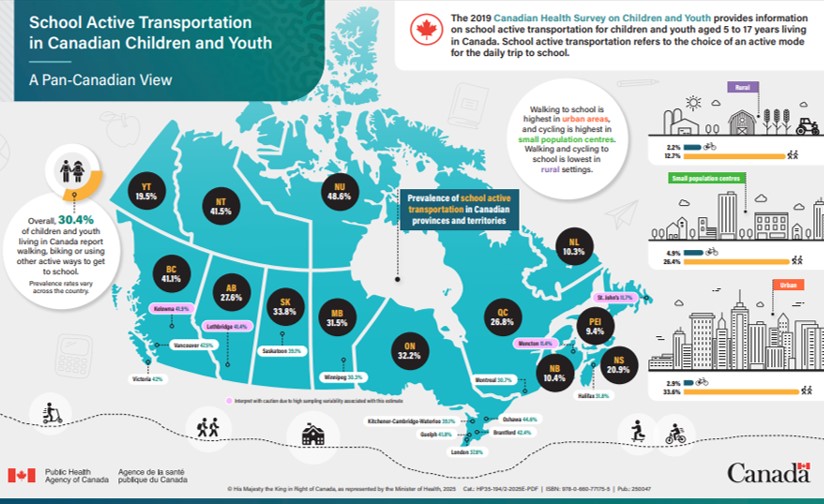
PEI is an interesting place. It is both the most densely populated province, and the least urban. According to Statistics Canada, Active Transportation rates to and from school on PEI are just 9% – the lowest in Canada, and less than half the rate in Nova Scotia.
So it was a great thing when six years ago, PEI’s Department of Transportation unveiled the Active Transportation (AT) Fund. It provided $5 million per year to municipalities and community groups looking to invest in Active Transportation projects. Community groups could receive funds to cover up to 100% of a project, while municipalities could receive matching funds to cover a portion of the cost (Full Disclosure: my institution received funding through this program for our first secure bike racks, which were recently unveiled and look awesome!).
There was coverage on this topic earlier this spring from CBC and The Guardian newspaper, but I thought I’d add a few thoughts here as well.
The AT Fund has been a wildly successful and popular program. It has provided more than $23 million in funding to both municipalities and community groups. I agree 100% with former Minister of Environment, Energy and Climate Action Steven Myers, who said:
Building more active transportation opportunities helps the province reach its net zero emissions goals while also making it easier and safer for Islanders to get outside and get active. We need to be here for our communities so they can build, expand or replace infrastructure, setting them up for success well into the future. To me, the active transportation fund is a win-win for communities, and we couldn’t do it without the support of community groups and municipalities taking on these exciting projects.
Here are some highlights:
- 112 bike racks for schools, such as ones at West Royalty Elementary School
- 35 km of shared active transportation pathways that are now popular locations for biking and walking
- 57 non-government organization projects approved
- 76 municipal and Indigenous community projects approved
- Signage, outdoor lighting and expanded trails that allow more people to explore the outdoors in communities like Cardigan, Cornwall, Kensington, Lennox Island, Miltonvale Park, Three Rivers and more.
- A variety of trail types including 39 separated pathways, six boardwalks, eight sidewalks, 17 new trails and 24 upgraded trails
- Community active transportation plans, education programs and projects
From a government perspective, many of these projects provided relatively small amounts of funding to reduce key barriers to active transportation (and in the case of municipalities, the provincial government was only paying half the cost of projects). For context, the budget for the Department of Transportation, Infrastructure and Energy was $317 million in 2025, meaning that the $5 million AT fund represented just 1.6%. So it really wasn’t a big part of the Transportation budget, but it had a huge impact on local communities. Understandably, people really liked this program!
Despite all the above, the AT fund was recently eliminated by the Government of PEI (the official wording was that the fund is “completed”). The reason for this was “financial pressures”. For months leading up to the cut, it was very difficult to get any information on whether the fund would continue or not, which made it difficult to plan projects with any certainty. The eventual cut happened just before construction season, when many groups who had applied the previous fall would have been hoping to get to work. This program could and should have been a really good news story – this Fund was a great idea that was making a real impact across PEI.
As Co-Chair of the MoveWell PEI Community Action Network, I (and many others representing other community groups) signed off on a letter asking the Minister of Transportation, Infrastructure and Energy to reconsider.
We received a response from the Department of Transportation, Infrastructure and Energy stating that “…as was stated in the legislature, this program is now completed due to financial pressures the province is currently facing. Tough decisions must be made and funding is only available to to complete previously approved projects.” No projects were approved this year, so basically projects approved in 2025 have a bit more time to be completed, but nothing else will be funded.
The budget for the Department of Transportation, Infrastructure and Energy remains at $279 million. The $5 million AT Fund represented less than 2% of that. As a province we haven’t decided to stop spending money on roads, but we are no longer spending money on things like bike racks at schools, or adding shoulders to existing roads so that people are less likely to be run over. Or as I put it in the CBC piece, “We haven’t stopped funding transportation, we just stopped the part that helps people walk and bike and be healthy in their communities.”


Leave a Reply